No-Till Doesn’t Mean No-Weeds: How to Manage Weeds in a Mulched Garden
“Mulch is a powerful ally—but only if you stay in the fight.”
Will Mulch Really Eliminate All Your Weeds?
There’s a popular claim that pops up in no-till gardening content: “If you mulch your garden, you’ll never have to weed again.” While it’s true that organic mulch—like wood chips, straw, or shredded leaves—can drastically reduce weed pressure compared to bare soil or tilled systems, it’s misleading to suggest these practices eliminate weeds entirely.
Mulching Was Enough—Until It Wasn’t
When I first heard about the concept of no-till gardening and the claim that applying mulch could eliminate the need to weed in a vegetable garden, I was intrigued by the idea. I live in one of the most forested states in the U.S., where free wood chips are rarely in short supply. I’d never seen anyone mulch their annual beds, but it felt like a gardening practice tailor-made for my region. I embraced the idea, began hoarding arborists’ wood chips, and spread them as thick as possible over my garden. For the first few years, it worked. Was my garden totally weed-free? No. But only a handful of weeds managed to poke through the mulch, and none of them caused any real trouble. Sadly, this honeymoon phase didn’t last. What started as a trickle turned into a takeover.
When Perennial Weeds Fight Back
Years into the experiment, a couple of perennial weeds began to spread throughout my garden. I ignored them at first, committed to my goal of not weeding, and assumed that a few weeds here or there wouldn’t do much harm. I’d pull one on occasion, but I mostly hoped that I could smother them with enough mulch in my next application. Unfortunately, over time, despite my best efforts, they began to wreak havoc on my garden.
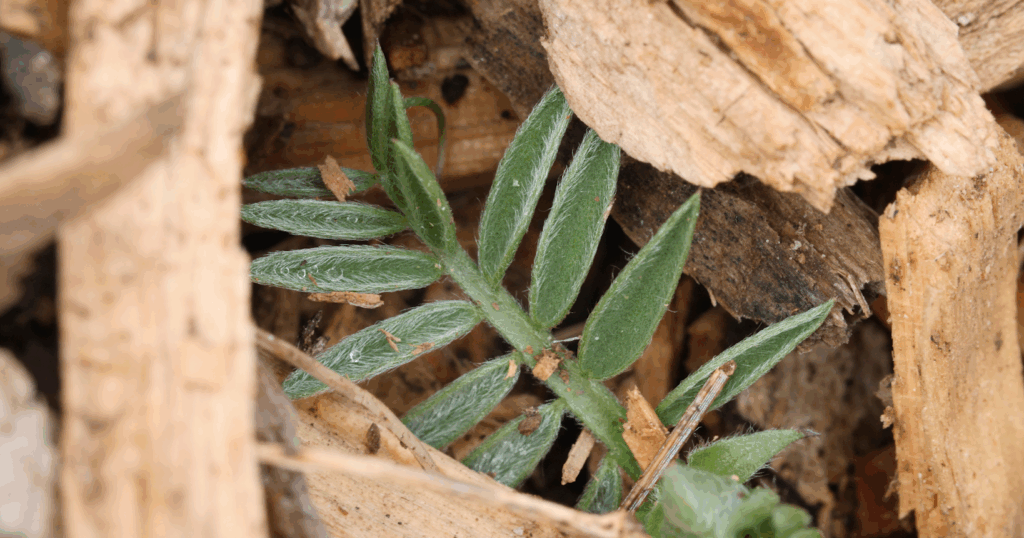
One of the offenders was crown vetch. It’s a relentless weed that spreads through both seeds and rhizomes. For those unfamiliar with rhizomes, they’re underground stems that grow laterally under the soil and send out both roots and shoots, making them especially hard to eliminate. Leave behind even a tiny piece, and it keeps coming back. Mulching effectively reduces the germination of seeds, but it’s less effective at stopping the spread of these vigorous rhizomatous perennials once they’re well-established. In my case, crown vetch rhizomes were sending up shoots all over the garden. They were able to find their way through several inches of wood chips. If the problem had merely been aesthetic, I wouldn’t have minded. The trouble was that vetch is a climber that uses its tendrils to wrap around anything nearby. In doing so, with a little help from gravity, it pulled apart my chives, toppled pepper seedlings, and became tangled in pumpkin vines. After a few seasons of trying to coexist with the stuff, I relented that mulching as a lone solution to weeds wasn’t enough.
If Mulch Isn’t Enough: What Comes Next?
Here’s the thing: aggressive mulching really does suppress weeds. This is a well-studied fact. But the tradeoff is that when rhizomatous perennial weeds become established, your options for dealing with them are reduced. You can’t just break out the rototiller and repeatedly chop up the rhizomes to disrupt their spread. So how do you manage them? There are several options.
Hand Pulling and Mechanical Weed Control
Mechanical weed control refers to physically removing or disrupting weeds using tools or manual labor. This can mean hand-pulling or using something like a Cape Cod weeder to cut or remove weeds at or below the soil surface. You might be thinking, “Isn’t that the very thing you were trying to avoid all along?” Why, yes! It is. But it turns out that regular hand weeding combined with aggressive mulching is a winning combo.
While methods like hand-weeding are labor-intensive, they can be highly effective when paired with cultural practices like deep mulching, crop rotation, and close plant spacing. Mulch suppresses and weakens the weeds, and you pick up the slack and finish the job.
Annual weeds are relatively simple to pull or slice off at ground level, especially if they haven’t set seed. And your mulch layer should do a good job reducing these. But for perennials, especially rhizomatous types like the aforementioned crown vetch or Canada thistle, you’ll need to dig deeper. In these cases, getting the entire rhizome out as intact as possible is key. They break easily, so don’t expect to get everything in one go.
Mechanical control isn’t glamorous, but it’s reliable. Once weeds are well-established, they become a much bigger chore to remove. It’s worth working to avoid that.
Solarization
Solarization is the process of covering soil with a clear plastic sheet to trap solar heat, raising soil temperatures to levels that kill weed seeds and seedlings. Moistening the soil before laying the plastic encourages weed seeds to germinate, only to be destroyed by the heat shortly after.
While solarization is particularly effective against annual weeds, its ability to control rhizomatous perennials depends on multiple factors: the depth of the rhizome, the intensity of the heat, and how long the plastic remains in place. Colorado State University Extension notes that maintaining soil temps above 99°F (~37°C) for 2–4 weeks can reduce annual weeds significantly. Tougher perennials will persist and require longer exposure. For this reason, solarization should be done during the hottest months of the growing season to have any hope of working.
As for the downside? There are some concerns about the impact it has on beneficial soil organisms. However, a study from UC Davis indicated that while beneficial microbes do decline temporarily, they tend to rebound within weeks to months—especially when compost or mulch is added afterward to reintroduce biology. It’s also worth noting that this isn’t a viable solution for those of us who interplant herbaceous perennials and annuals in the same beds.
Solarization is a useful tool, but not a silver bullet.
Occultation (Tarping)
Occultation, as known as tarping, is a weed management strategy that involves covering soil with a light-blocking tarp to exclude sunlight, trap moisture, and slowly kill weeds. Unlike solarization, which uses clear plastic and relies on sunlight to heat the soil and kill seeds with high temperatures, occultation works by blocking light and preventing photosynthesis. Weed seeds may still germinate beneath the tarp, but without access to light, they quickly die.
The University of Maine Cooperative Extension states that occultation can be particularly effective against cool-season annuals. However, it notes the limitations of this practice for managing perennial weeds and the fact that some perennial species are not well controlled via tarping.
As for timing, it is suggested that perennial weeds are most vulnerable to tactics like tarping as they emerge in the spring, because they have drawn on stored sugar reserves to survive the winter and must exhaust those reserves to form spring shoots.
Ultimately, tarping can be utilized to help manage perennial weeds, but is best suited for managing annuals.
Chemical Controls
Yes, herbicides exist. Yes, they can be effective at killing weeds, including tough perennials and rhizomatous invaders. But in a home garden setting, chemical controls come with trade-offs that are hard to justify.
Most common herbicides used in agriculture—like glyphosate or 2,4-D—are non-selective or broadleaf-targeting and can damage or kill your vegetables just as easily as your weeds. Even carefully applied, they can drift or leach, potentially harming nearby plants, beneficial soil organisms, and even pollinators. In a home garden, that’s a risk that’s generally not worth taking.
There are “organic” herbicide options too, but these tend to be contact-only, meaning they burn the tops of plants but don’t affect deeper roots or rhizomes. That makes them largely ineffective for the kinds of weeds that pose long-term problems in mulch-based gardens. You might feel productive using them, but the weeds will likely be back in a week or two.
So while chemical controls are technically part of the weed management toolbox, they come with environmental, health, and practical concerns. There are better, safer methods that can do the job with fewer possible negative outcomes.
The Key Takeaway
Weeding is always going to be part of the process. No-till gardening and heavy mulching aren’t magic solutions, and anyone claiming you’ll “never have to weed again” is selling a fantasy. But if you mulch well and stay on top of weeding as part of your regular routine, you’ll find yourself weeding far less often than in a traditional garden.
In the end, mulch is a powerful ally—but only if you stay in the fight.
Additional Resources:
Iowa State University Extension and Outreach: Weed Control in the Vegetable Garden
University of Minnesota Extension: Using the sun to kill weeds and prepare garden plots